Children are full of grit! They are so capable! They can be so resilient! As the adults in their lives, we have to help them to build those skills.
Angela Duckworth has done some really interesting research on grit, what it means and how it's built.
Angela teaches that effort is so much more important than talent in measuring success! I know that from personal experience as someone who doesn't feel naturally talented at many things this can be super hopeful! Persistence can be just as important as natural intelligence. I like that Angela talks about the 10,000 hour rule as well. The idea of the 10,000 hour rule is that you can be successful in something after you spend 10,000 hours deliberately practicing that thing. Deliberate practice is hard but will help to build grit. People with grit will be more successful in life overall.
Carol Dweck discusses and researches mindset and how important it is to have a growth mindset. The opposite of a growth mindset is a fixed mindset. A fixed mindset is where people believe that their intelligence is fixed (meaning it can't necessarily grow). A growth mindset is when someone believes that their intelligence can be developed. Growing up, my schools always talked about the importance of becoming a lifelong learner and I think the idea of a lifelong learner and having a growth mindset go hand in hand. People with a fixed mindset are typically very concerned about how they are being perceived whereas people with a growth mindset are more concerned about their learning. Fixed mindset learners tend to believe that if you have to work hard then that means you aren't smart enough. Growth mindset learners believe that working hard and putting in effort is what makes you smarter.
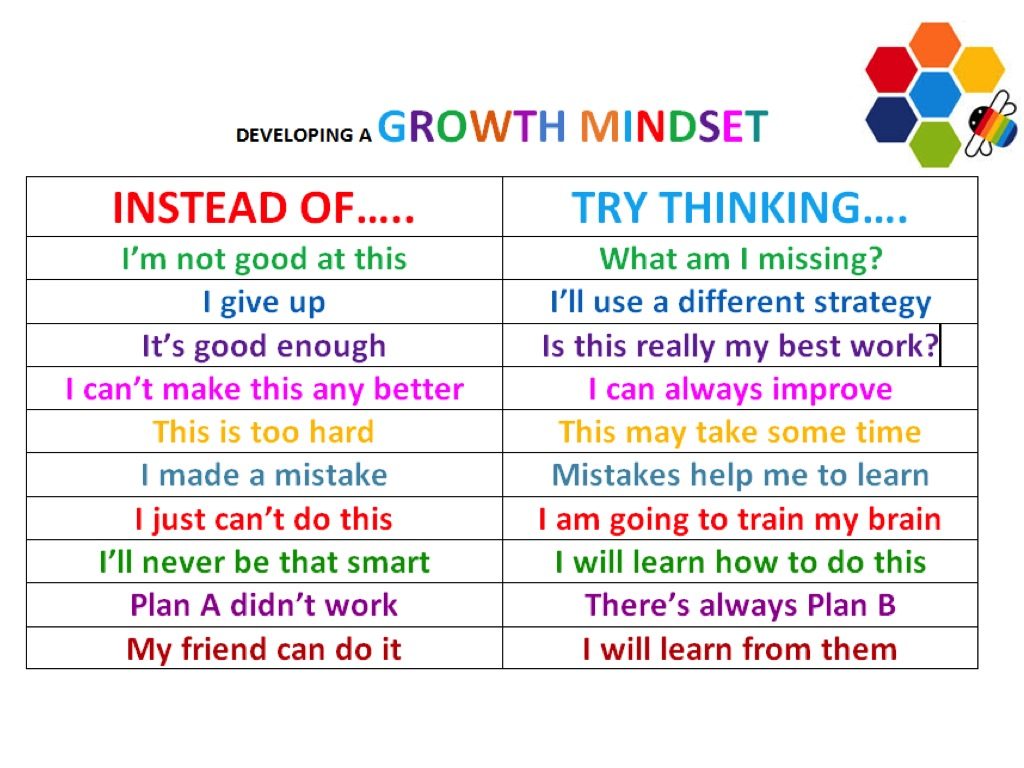
Our brains are amazing and there is brain plasticity through learning especially in younger children. This has been shown in MRI's and various studies. That means that mindsets can change! As neurons form, you get smarter and those with a growth mindset will be able to form those neuron connections. Carol Dweck talks about how it should be a human right to have access to schools that promote growth mindsets and I think that is so cool! How can we better help schools promote and teach about growth mindsets?
Metacognition is the idea of thinking about how you think. You have to train your unconscious about how to see and perceive the world. This process can help children to develop a growth mindset. In order for this to be the case, children need to see good examples of people in their life who have a growth mindset, who are lifelong learners, and who are gritty.
Teaching our children to put forth the effort can be difficult but one way that we can do so is in how we praise our children and the kind of motivation we place in their lives (intrinsic or extrinsic).

Joanna Pocock of JSTOR Daily says that "well-accepted studies in this area come to the conclusion that, yes, in many ways our well-intentioned tendency to lavish our offspring with praise is fueling a generation of narcissists". What can we do to change those narcissistic thoughts? Focus on descriptive and appreciative praise! When you are giving praise, it should be focused on the effort that the child has put in as opposed to the actual product they have created. The following video has some really good advice about how to praise your children!
Sources:
Education Nation. (2012, September 24). True Grit, Can You Teach Children Character? [Video]. NBC News. https://www.nbcnews.com/video/true-grit-can-you-teach-children-character-44432451969
Pocock, J. (2017, February 22). Are We Spoiling Our Kids with Too Much Praise?. JSTOR Daily. Retrieved October 23, 2020, from https://daily.jstor.org/are-we-spoiling-our-kids-with-too-much-praise/
Productivity Game. (2016, June 9). GRIT by Angela Duckworth | Animated CORE Message [Video]. Youtube. https://www.youtube.com/watch?v=sWctLEdIgi4
The Swaddle. (2018, April 6). How To Praise and Encourage Kids [Video]. Youtube. https://www.youtube.com/watch?v=j3hyvI84KaE
TeachHUB.com. (2019, January 17). Understanding Metacognition - Video Podcast [Video]. Youtube. https://www.youtube.com/watch?v=grSw_n0xZUk
Comments
Post a Comment